Preaching at Marquand Chapel
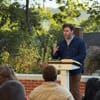

Earlier this month, I had the privilege of preaching at Yale Divinity School's Marquand Chapel. The appointed Gospel for the day was Matthew 9:18-26, which narrates the story of Jesus healing a woman who suffered from hemorrhages and bringing a young girl back to life. This story appears in all three synoptic gospels; in each, Jesus proclaims some version of "your faith has made you well" after the woman is healed. In this sermon, I reflect on what that could mean for us.
A stunning truth is revealed in the incomparable 2001 Academy Award-winning masterpiece Shrek. The titular character, and our hero, shares about himself that “Ogres are like onions.” Donkey, Shrek’s faithful companion, then guesses at his meaning—perhaps it’s because they both stink, or because they both make you cry—but Shrek insists it’s because they both have “layers.” However, he does little to clarify his meaning. For Shrek, the meaning is self-evident: to quote, “Ogres have layers, onions have layers. You get it! We both have layers.”
I would like to suggest that Shrek has layers in at least two senses. In one sense, Shrek is pointing to his own depth—like the stratified meaning that we have the opportunity to explore here at divinity school as we dissect biblical texts and seek to unearth intertextual resonance. However, in another sense, I think Shrek is suggesting that his layers act as a cover—to hide, to conceal, or to occlude his true self. He is admitting that he is hiding behind multiple versions of himself, like a sort of Russian nesting doll.
I think “Faith,” like Shrek, also has layers—and I mean that in both of the senses I just talked about. It has accumulated positive meaning over the centuries, giving the word depth. But, I believe, like barnacles that cling to a ship’s hull, it has also acquired some unhelpful connotations, which slow down or hamper our ability to understand what is meant in our reading today. So, when Jesus says, “Take heart, daughter; your faith has made you well,” it is possible that there are about as many interpretations of that as there are people here today.
There are many definitions of faith that we could reach for. Let’s try and peel back a few. Looking to scripture, the first that comes to mind is perhaps the one from the eleventh chapter of Hebrews: “Now faith is the assurance of things hoped for, the conviction of things not seen.” While I am a fan of reading across Scripture for meaning—and letting Scripture interpret Scripture—I’m not sure if the author of Hebrews’ definition provides much more clarity or makes understanding faith a less heady enterprise.
So maybe I could turn to theology. Friedrich Schleiermacher is somewhat famous for saying something like, faith is “the feeling of absolute dependence upon God.” Uuh not sure. (Of course, there are academics who take issue with this English translation of Schleiermacher’s words.) But I think this definition does a good job of explaining what many of us mean when we use the word in everyday speech—like when we say, “so-and-so has a strong faith.” I think we mean something like that: that so-and-so has particularly pious feelings, or can relate much of their own experience to God. They have a large sum of pious thoughts, or something like that. But if the story of the mustard seed teaches us anything, it’s that faith’s strength or efficacy has almost nothing to do with its size. However, despite this truth, I often find myself urging people to have “more faith,” as if a little bit more is what they need to persevere through the struggles they face.
Most often, the person I tell to have “more faith” is myself. And I often stay at these outermost layers when I think about faith. I probably start a layer even further out than Schleiermacher’s. I’m not at the level of thinking about faith as “the feeling of absolute dependence upon God.” Instead, I’m stuck out beyond that point at the evaluation of my own sense of dependence. I’m stuck wondering whether I have enough or too little. And even if I arrive at the conclusion that I have adequate faith, well, that isn’t anything like faith in God; it’s more like faith in my faith.
I remember coming to YDS without a clear path of what I would do afterward, and still trying to figure out where I was supposed to serve the church. I was major stressed. I remember Dean Awet catching me in one of my first few weeks at Divinity School, offering to pray with me in the lounge over there. I didn’t have faith that anything would work out; I didn’t even know if it made sense to continue here. I didn’t know what I was doing here, I didn’t know why I was uprooting my life in NYC. But with a gentle touch on my shoulder and a quick prayer, she gave me some of the faith I desperately needed–to trust not in myself but in God because God knew what he was up to.
No, faith in my faith is no good. It leaves me stressed and straining, worried about all the things I can’t control—slumped over on the couch in the lounge, striving to make things happen that only God can do. Faith in my faith puts all the burden on my own shoulders.
“Take heart, daughter; your faith has made you well.” What could Jesus have meant by this? What is it that made this woman such an exemplar of faith?
Jesus is able to look past all the things that block our human ability to judge. He can look at us as we truly are. And surely, as he looks at her, he does see her suffering—suffering that wasn’t just physical, but that would have also made her, according to the Law, ritually unclean. It would have made it impossible for her to participate in the religious life of her community. But it wasn’t her suffering that made her faith; it was her faith that sustained her, in spite of her inability to participate in the official religious life. It was her faith that helped her to endure pain and frustration. In other words, her faith is God-given, but her suffering is not.
I know that I’m treading in dangerous waters, speaking about the definition of faith in this place. I mean, Prof. Teresa Morgan wrote the literal book on that subject. But, putting aside my apprehension, I think that one of the reasons that “trust” is so often given as a substitute for faith—and as a good translation of the Greek word πίστις—is that the word trust in English, unlike faith, can take a direct object. It makes sense to say, “I trust Jesus,” but not “I faith Jesus.” I have to say, “I have faith in Jesus,” which doesn’t get to the point as quickly and makes Jesus an indirect object.
I think the woman from our reading understands this in ways I often fail to. She understands what it means to get directly to the point, as she speeds toward Jesus. She understands that the object of her faith is passing by, and she reaches out to touch him—to touch faith itself. Without much else to cling to, she clung to Jesus, with the conviction that he would make her whole.
We love to put adjectives before faith—strong, weak, steadfast, unwavering, living, blind, authentic, quiet, personal, saving. But faith isn’t something we can easily measure, with an adjective of quantity or quality. Rather, it’s whatever causes us to look up and to reach toward Jesus. The woman from our reading does just that. She doesn’t pause to evaluate, quantify, or measure her own faith. She has something more direct—she faiths Jesus, without any time for proper prepositions.
Jesus, whose own faith was sight, and who sees us as we are. Who takes our faithlessness and makes us well, and gives of himself all that he has. Jesus, who even has the power to raise the dead.
So, take heart, friends, as we wait for Jesus to pass by.
Amen.