Taken, Blessed, Broken, Given.
Last week I had the opportunity to preach my senior sermon at Berkeley's Community Eucharist. The gospel text was Luke 19:1-10.
Yesterday, Dagny and I took a short walk along the Farmington Canal Trail. She wanted to show me some trees that autumn had utterly transformed—verdant greens were now suddenly bright, warm hues. We saw a red maple, the exact color of flaming-hot Cheeto dust. We saw a series of ginkgo bilobas, which were somewhere on the yellow side of chartreuse. As I looked at these trees and considered what I might say today, I thought, I don’t think I can climb these trees.
I’ve never been much of a climber. (Being a Jacob, I’m partial to ladders.)
But, from my research, I discovered that the sycamore fig Zacchaeus climbed is quite different from the trees Dagny and I found on the Canal Trail. It has a wide, spreading crown, often with branches that begin to jut out just a few feet off the ground. What’s more, it has lots of knobbly bits, and its bark has holes and is easy to grip. It’s kind of perfect for climbing. Maybe I could climb that kinda tree.
The story of Zacchaeus, which is unique to Luke’s gospel, is one that I can remember returning to time and time again in Sunday school. I suspect that it had something to do with having the flannel board characters for this story. But it makes sense why the story is included in so many Sunday school curricula: it deals with two things many kids can relate to—namely, climbing trees and being small. And it provides ample opportunity to teach kids that Jesus is the type of person who likes small people and even those climb trees, that they shouldn’t. Jesus wants to meet them, to hang out with them, to be their friend.
But I confess, I haven’t given the story much attention in adulthood. In reading this account in preparation for tonight, I’m struck by details that might not have caught my childhood imagination. We’re told Zacchaeus was a chief tax collector and had managed to get rich through his enterprise. He was responsible for collecting taxes from the local tax collectors, which Nelson spoke about last week.
In some ways, this story brings to life the parable told last week from the previous chapter (Luke 18:9–14). Instead of a fictional tax collector, we meet the real-life Zacchaeus, who “ran ahead” and “climbed up a tree” just to catch a glimpse of Jesus as he passed by. And then the unimaginable happens: Jesus sees him and calls him by name. Zacchaeus was determined to try to see who Jesus was, but it turns out Zacchaeus gets more than he bargained for. Jesus is determined to stay at his house and break bread with him. Zacchaeus, who no self-respecting person would be caught dead with, because, of course, Zacchaeus was a traitor to his people. But, Jesus saw Zacchaeus—for real, for real—and that made all the difference.
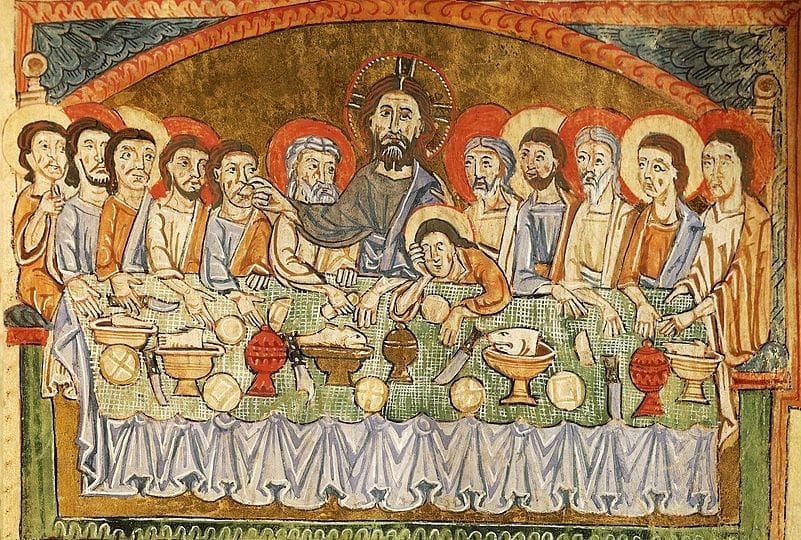
And Jesus gets up to what Jesus always gets up to: breaking bread. That often gets him into trouble. Jesus is always hanging out with the wrong kinds of people—those who are too poor, too sinful, or, in this case, too rich through unsavory means. He’s not very interested in respectable people; they’re too caught up in their self-justifying projects and too worried about what being seen with Jesus might do to their reputation, lest they be found guilty by association. But, despite the bad rap, he continues to break bread with outcasts, traitors, and ne’er-do-wells. In fact, breaking bread is so quintessentially Jesus that it’s almost hard to recognize who he is without him breaking bread, as we find out in the 24th chapter of Luke’s gospel, on the Road to Emmaus.
Which reads, “When he was at the table with them, he took bread, blessed and broke it, and gave it to them. Then their eyes were opened, and they recognized him.” Truly, he was “made known to them in the breaking of the bread” in his resurrected life, because that was the shape of his earthly ministry. Because “Taken, blessed, broken, and given” isn’t just the shape of our liturgical celebration, but is the fundamental pattern of Jesus’ life, who always breaks bread and shares communion with those he shouldn’t.
Last week, Nelson gave us a wonderful meditation on our brokenness and the Christ who is broken for us. But, I believe this narrative provides ample opportunity for us to move from broken to given, or from fractured to distributed—because being seen by Jesus—for real, for real—changes Zacchaeus.
Zacchaeus, coming face to face with his Lord, like Abraham, is determined to meet him with hospitality. Abraham rushes to accommodate his otherworldly guest. But Zacchaeus recognizes there’s more that this encounter requires of him than using the choicest flour to make cakes or killing the fatted calf. No, when Jesus shares his life with Zacchaeus, Zacchaeus knows that he must share his life with those around him. He must use what resources he has gained with his community—especially giving to those he has harmed. Zacchaeus is taken with Jesus, blessed, is broken by being seen in his brokenness, and now has no choice but to give what he’s been given.
But, most of the time, faith can feel like waiting—like the moment just before we meet Jesus, like sitting in a sycamore tree hoping to catch Jesus as he passes by, or waiting in the watchtower like Habakkuk, for God to answer us. From that vantage point, from in the watchtower, we can’t help but become disillusioned by all the horror we see around us. We see the pollution of our planet and poisonous political rhetoric; our neighbors struggle to make ends meet working multiple jobs and are being snatched away; apocalyptic views are becoming commonplace, as we feel that our society and world are at a precipice.
In some ways, this is where the rest of our readings find us—waiting for the Lord to turn the corner and set the world right. Habakkuk’s bold prayer toward God lodges a formal complaint to the Most High: How long is it going to take for you to listen, O God? You see what’s going wrong with the world—how broken it is—when will you act and set things right? When will you establish justice on earth?
And when God speaks, we find that he is even more furious than about economic inequality, predatory lending, the abuse of laborers, and leadership that worships money and defrauds its people than we are. But the answer God has for us isn’t one Habakkuk, or we, really want to hear. See, the Lord is raising up the armies of Babylon to destroy them. Basically, things are going to get a lot worse before they get better. And our only hope is found in living by faith, in the meantime, that God will bring about what’s been promised.
Faith acts as a bulwark against the age we find ourselves in—not because faith ignores the issues or looks for a silver lining, but because faith knows a secret. Faith knows that the Lord is coming, that he has defeated the unholy trinity of sin, death, and the devil. In the meantime, we should lament like Habakkuk and, by prayer, set about rubbing God’s promises in his ears. We who are small and of little account, or even short in stature; we who have experienced trouble and distress, can delight in the pronouncements of God. Faith in this God allows us to endure persecutions and afflictions because Jesus has not only allowed himself to be broken for us but is being distributed and poured out among us, even now. And we’re invited into that sort of life, a broken and then distributed sort of existence. To share what we’ve been given as if the life that God will establish has already come, because it's surely coming, and even now is in breaking.
As much as we might try to climb our way up to get a glimpse of God–whether by reason, good works, or mystical spirituality–we have a God who meets us right where we’re at. Jesus shows us we have the kind of God who says, “I’ll meet you at your house today.” Jesus isn’t worried about being seen communing with you—let them complain that he is the friend of sinners and lost ones, it turns out that’s exactly who he’s after. In fact, God takes none but those who are forsaken, blesses none but the broken. He sees us, knows us, and promises to meet us in the breaking of the bread. Together in that communion with him, we find a God who, instead of needing us to climb up to see him, climbs up his tree at Calvary so we can see him — and so that he can see us — see us through and beyond this age into the age to come.
Amen.